Publication date: 22.04.2026
Reading time 8 Min
What is Electronic Data Interchange (EDI)?
EDI IntegrationWhat is EDI (Electronic Data Interchange)?
Millions of EDI messages are exchanged worldwide every day. Standardized, automated order processing increases productivity and enables companies to use their resources more efficiently. Businesses of all sizes benefit from electronic data interchange as a foundation for effective data management and sustainable growth. EDI stands for scalability, connectivity, and maximum data security – delivering a real competitive advantage in an increasingly digital economy.
Definition: What does EDI mean?
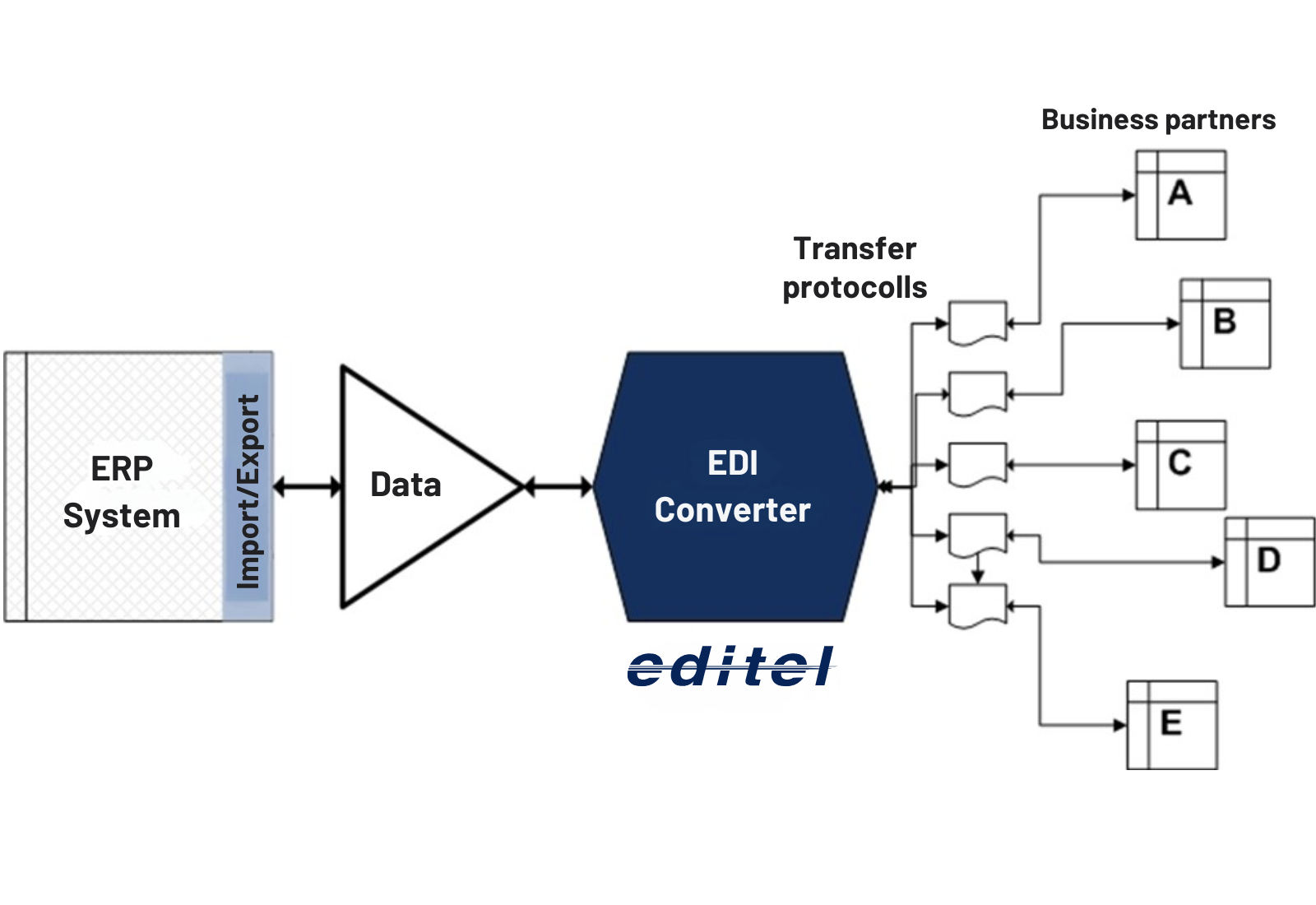
EDI (Electronic Data Interchange), or electronic data interchange, refers to the standardized exchange of structured business documents, such as purchase orders, delivery notes, or invoices, between the IT systems of business partners. The data transfer is fully automated, takes place in real time, and requires no manual intervention. This reduces sources of error, improves data quality, and creates greater transparency and efficiency across the entire supply chain.
Key EDI Messages and Standards
Products, processes, and supply chains vary from one company to another. To ensure smooth electronic data interchange (EDI), defined EDI messages must follow uniform formats based on predefined standards that are understood and consistently applied by all business partners. These standards determine how documents such as purchase orders, invoices, or dispatch advices are structured and which information is transmitted.
Common EDI Messages
- PRICAT (Price/Sales Catalogue) is an EDIFACT message used to exchange product, pricing, and product range data between business partners. It enables the supplier to send the buyer up-to-date information on products, prices, and terms.
- ORDERS (Purchase Order) is used to exchange order information between business partners. This message initiates the ordering process and contains all relevant details, such as item numbers, quantities, prices, and delivery dates.
- DESADV (Dispatch Advice / electronic delivery note) is sent by the supplier to the customer and contains information about the materials and goods to be delivered. In most cases, the DESADV message is transmitted before the physical delivery takes place. This allows recipients to plan goods receipt, acceptance processes and downstream production activities more efficiently and well in advance.
- RECADV (Receiving Advice) confirms the physical receipt of a goods delivery. This message is used to document any discrepancies between the original purchase order (ORDERS) or the dispatch advice (DESADV) and the goods actually delivered. RECADV also serves as an important basis for issuing a correct invoice (INVOIC).
- INVOIC (Invoice) is used to exchange invoice information between customers and suppliers. Relevant metadata from previous messages can be transferred automatically, helping to streamline invoicing processes and reduce manual effort. In the automotive industry, self-billing is also widely used, meaning the customer issues the invoice on behalf of the supplier.
EDI standards define the structure of electronic documents and ensure that data can be interpreted and processed consistently across different IT systems. This reduces sources of error and harmonizes processes across companies and national borders.
Overview of the most common EDI message standards:
- UN/EDIFACT is the most widely used EDI standard worldwide for the structured exchange of electronic business data. Developed by the United Nations in the late 1980s, it includes more than 200 message types and is now used by hundreds of thousands of companies across industries around the globe.
- EANCOM (GS1) is a subset based on UN/EDIFACT and uses GS1 identification systems to uniquely identify products, locations, and logistics units, in particular the GTIN (Global Trade Item Number), GLN (Global Location Number), and SSCC (Serial Shipping Container Code).
- ANSI X12 is an EDI standard authorized by the American National Standards Institute (ANSI) and was developed in 1979 by the Accredited Standards Committee X12 (ASC X12). Its purpose was to create uniform formats and rules for the electronic exchange of business documents between companies. The standard is used primarily in North America and supports a wide range of cross-industry business processes.
- UBL (Universal Business Language) is an international XML standard for the structured digital representation and exchange of business documents. It enables different IT systems to read and process documents such as purchase orders, invoices, and delivery notes automatically and without delay.
- VDA (German Association of the Automotive Industry) is an industry-specific EDI standard used primarily in the automotive sector. It defines structured message formats for the electronic exchange of logistics and production-related information between vehicle manufacturers and suppliers within complex supply chains.
How does EDI work? An overview of the electronic data interchange process
The EDI process follows four clearly defined steps: data preparation and mapping, transmission, processing and integration, as well as monitoring and operations.
Benefits of EDI
Electronic data interchange offers clear benefits for both businesses and public sector organizations. Here is an overview of the key benefits:
EDI compared to traditional communication methods
Unlike paper-based processes, EDI solutions offer clear advantages. Traditional communication methods such as email or PDF require manual intervention and often result in media disruptions and inefficient workflows. EDI enables direct system-to-system communication, allowing data to be processed consistently throughout the entire business process without being re-entered.
Comparison: Traditional communication methods vs. EDI
| Features | Traditional communication methods (Email, PDF) | EDI-based communication |
|---|---|---|
| System integration & Interfaces | Manual data entry and media switches between systems | Fully automated system - to-system communication without media disruption |
| Data quality | High risk of input and transmission errors, with no standardized or system-supported validation | Validated, structured data formats – significantly lower error rates |
| Speed & Cycle times | Delayed processing and manual forwarding of attachments | Near real-time data exchange – from purchase order to invoice |
| Scalability & Partner connectivity | New business partners often require additional manual coordination and integration work. | Standardized EDI networks (e.g. eXite®) enable the rapid onboarding of numerous business partners. |
| Traceability & Monitoring | No standardized status tracking and limited auditability | Complete process control with monitoring, reports, and audit trails |
| Costs & Resource consumption | High effort due to paper, printing, postage, and manual labor | Lower costs through digital workflows and significantly reduced resource consumption |
| Security & Compliance | Varying security levels, in some cases with unencrypted transmission | High security through protocols such as AS2 and audit-proof traceability |
Implementing EDI – Challenges and solutions
Introducing EDI is far more than a technical project. It requires end-to-end processes, reliable data, and a stable operating environment – in short, the seamless interaction of technology, organization, and expertise. EDITEL supports companies with proven concepts, clearly defined responsibilities, and hands-on implementation support, from initial planning through to go-live.
The following points summarize common challenges – each paired with practical solutions:
- Heterogeneous partner requirements
Different formats, protocols, and validation rules can make implementation more complex from the start.
Solution: Partner profiles for each message type, clean mapping rules, clearly defined test cases, and a structured onboarding process through to productive operation. - ERP integration & interfaces
The variety of systems involved – such as ERP, WMS, or TMS solutions – often leads to media disruptions and unclear responsibilities.
Solution: Clearly documented interfaces, validation at the source, and well-defined roles between IT and business departments create greater transparency and stability. - Master data quality
Incorrect product, partner, or pricing data has a direct impact on process quality and billing accuracy.
Solution: GS1-compliant data management, binding governance rules, and regular reviews are essential for smooth and reliable processes. - Operations, security & SLAs
Certificate lifecycles, key management, and system availability are business-critical risk factors.
Solution: Managed EDI operations with monitoring and alerting, clear service level agreements, and audit-proof logs and reports strengthen traceability and process security. - Scaling & internationalization
As the number of connected partners grows, so does complexity.
Solution: Reusable mappings and country-specific profiles, such as EN 16931/XRechnung or Factur-X, ensure scalability and future readiness. EDI networks such as eXite® simplify the efficient onboarding of new business partners – including across international borders. - Regulatory requirements & roadmaps
Standards and e-invoicing roadmaps are evolving dynamically, for example EN 16931 and ViDA.
Solution: Continuous compliance monitoring and forward-looking release and roadmap planning help companies remain compliant over the long term. - Change management & know-how
Limited acceptance, unclear responsibilities and a lack of expertise can hinder the long-term success of change initiatives.
Solution: Target-group-specific training, clearly defined responsibilities, and transparent communication around status and monitoring close information gaps and help ensure a successful transition.
With these foundations in place, an “IT project” becomes a manageable implementation program – and the next section focuses on the concrete roadmap for execution.
The Future of EDI
EDI remains the backbone of digital data exchange and continues to evolve into a core component of harmonized, audit-proof, and automated business processes. In Europe, the future of EDI is being shaped by the ViDA (VAT in the Digital Age) initiative and new digital reporting requirements. These developments are driving the widespread adoption of mandatory electronic invoicing and creating uniform, standardized reporting structures.
At the same time, managed EDI models and cloud-based solutions are becoming increasingly important, as they centralize operations, monitoring, and archiving while enabling scalable and secure processes. In addition, hybrid models combining EDI and API integration are gaining traction, bringing together real-time communication with the stability, standardization, and compliance benefits of traditional EDI standards.
Conclusion: Companies that invest in EDI processes today benefit in two ways: operationally, through greater efficiency and transparency, and strategically, through future readiness and the ability to meet upcoming European requirements for electronic invoicing and digital reporting.

Transform your business with efficient EDI processes
Would you like to learn more about how EDI works in practice, or are you planning to implement or expand your EDI processes?
The experts at EDITEL will be happy to support you – from the initial analysis through to implementation.
FAQ
EDI (Electronic Data Interchange) refers to the structured, standardized exchange of business data between IT systems, such as purchase orders, dispatch advices, or invoices. Data is transferred automatically, securely, and without manual intervention.
The EDI process consists of four steps: data preparation and mapping, transmission, processing and integration, as well as monitoring and operations. Providers such as EDITEL support companies with mapping services, partner onboarding, and centralized monitoring via platforms like eXite®.
EDI automates business processes, reduces error rates, and shortens cycle times. Companies benefit from higher data quality, greater transparency, and measurable efficiency gains across departments and business partners.
At international level, UN/EDIFACT and the GS1 subset EANCOM, which is based on it, are among the leading standards. XML formats such as GS1 XML and UBL are also widely used. In addition, there are industry-specific standards, such as VDA in the automotive sector. Overall, many other formats exist — only some of the most commonly used ones are mentioned here.
Peppol is an open, international network for the secure exchange of electronic business documents, especially e-invoices. Based on the EN 16931 standard, it enables interoperable and standardized data flows between businesses and public authorities.
The standard defines a uniform semantic data model for electronic invoices in Europe. It ensures interoperability, legal certainty, and seamless processing across national borders.
ViDA (VAT in the Digital Age) is an initiative of the European Commission aimed at modernizing the VAT system. Its objective is to reduce tax fraud and ease the administrative burden on businesses through digital processes. This includes reporting obligations based on electronic invoices, an expanded central registration system for cross-border transactions, and new rules for digital platforms. Implementation will take place in stages through to 2035.
EDITEL supports companies from initial analysis and pilot phases through to full rollout, with partner profiles, mapping rules, validations, and monitoring. The result is a stable, compliant solution from implementation to live operation.
EDI is valuable wherever business documents such as purchase orders, delivery notes, or invoices are exchanged with a large number of partners — for example in automotive, healthcare, the public sector, HoReCa, or e-commerce.
EDI provides stability, standardization, and compliance, while APIs enable real-time communication and greater flexibility. In practice, hybrid models that combine both approaches are becoming increasingly common.