Publication date: 29.10.2025
Reading time 7 Min
What is e-Invoicing
E-InvoicingTable of contents
Definition of e-Invoicing | Why is e-Invoicing important? | Legal requirements & Compliance | Benefits of e-Invoicing for businesses | How e-Invoicing works in practice | Challenges in implementing e-Invoicing | EDITEL solutions for e-Invoicing | The future of e-Invoicing | FAQ on e-Invoicing | Customer projects & success stories
e-Invoicing and ViDA: a guide for businesses on digital invoicing
Across nearly all European countries, lawmakers are currently establishing legal frameworks for mandatory electronic invoicing.
ViDA (VAT in the Digital Age) provides, among other things, that EU member states may introduce domestic e-Invoicing obligations as long as they apply only to resident taxpayers.
Most European countries are now creating the legal foundations for mandatory e-Invoicing. Many have already launched national systems — a decisive step toward a unified, digital solution.
Digitalization and automation of business processes are no longer just technical upgrades; they have become strategic necessities.
Companies that address these requirements early are not only on the right side of the law but also benefit from more efficient, transparent, and sustainable workflows.
Definition of e-Invoicing
e-Invoicing refers to the electronic issuing and processing of invoices based on structured, machine-readable data that IT systems can process automatically and without media disruption. The European standard EN 16931 defines which mandatory data fields every e-invoice must contain. Simple PDF invoices do not meet these requirements because they lack the necessary structured data and therefore cannot be processed automatically.
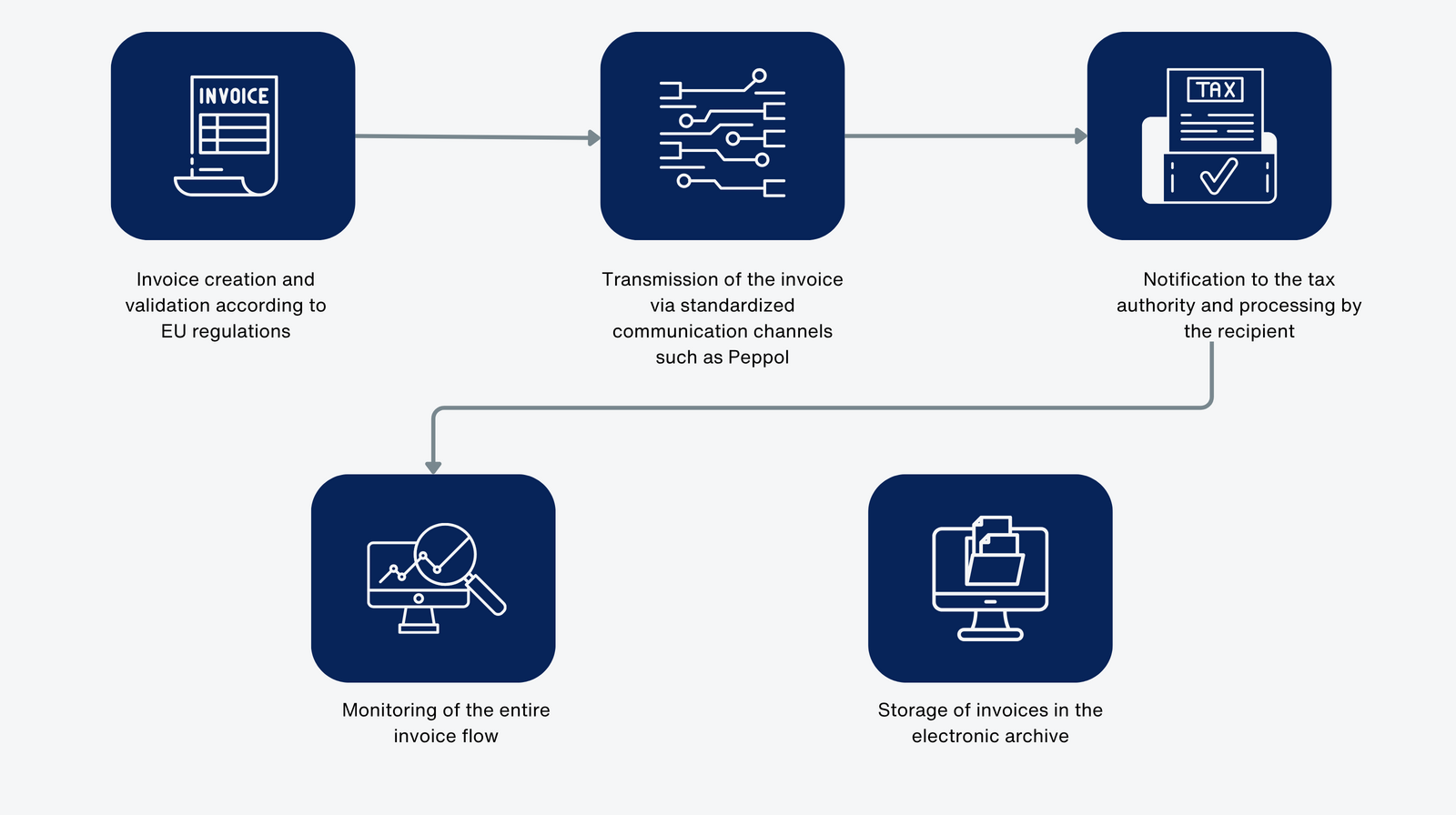
e-Invoicing is far more than just sending invoices electronically — it represents an end-to-end digital invoicing process: from creation in the ERP system to validation, secure transmission, automated processing by the recipient, and legally compliant archiving.
National implementations demonstrate the variety of approaches — from XRechnung in Germany and ebInterface in Austria to the KSeF system in Poland.
EN 16931 provides the overarching framework for all these formats. In practice, the most relevant are UBL (Universal Business Language) and UN/CEFACT CII (Cross Industry Invoice).
EDIFACT also remains one of the internationally recognized standards for electronic data interchange, widely used for many years in manufacturing, retail, and logistics.
Why is e-Invoicing important?
The relevance of e-Invoicing goes well beyond regulatory compliance. It not only fulfills legal requirements but also delivers tangible business benefits. Here are five key aspects at a glance:
- Central element of ViDA
ViDA designates the electronic invoice as the standard form of invoicing within the EU. e-Invoicing thus becomes mandatory for cross-border trade and VAT reporting. - Harmonization and interoperability
Until now, numerous national formats have coexisted across the EU. ViDA aligns them with the European standard EN 16931, paving the way for consistent, interoperable processes. - Combating the VAT gap
Each year, the EU loses hundreds of billions of euros to tax fraud and misreporting. ViDA leverages structured invoice data that can be automatically validated and transmitted to tax authorities — a powerful tool against VAT fraud. - Future readiness
National systems will gradually align with ViDA requirements. The obligation for B2B intra-EU transactions begins July 1, 2030. Full alignment for member states with real-time reporting will follow by January 1, 2035. Companies that adapt early ensure compliance and avoid costly retrofits. - Unified e-Invoice model
In the long term, a single structured invoicing model will apply to cross-border transactions within the EU, once a new European standard (potentially beyond EN 16931) is introduced. For now, national differences remain: many countries require invoices to be submitted to government platforms — even when addressed to partners in other member states.
In short: ViDA cannot be implemented without e-Invoicing. It is the core pillar of the initiative to make the European single market digital, transparent, and future-ready.
Legal requirements and compliance
ViDA as the European framework
With ViDA, the European Commission is launching a comprehensive reform of VAT rules, establishing binding requirements for structured e-Invoicing across Europe. The goal is a fully digital, standardized VAT and invoicing process that transcends national borders.
To take advantage of the benefits while remaining compliant, businesses should note the following:
- Legal foundation through ViDA: since the publication of the ViDA package in early April 2025, EU member states may introduce mandatory national einvoicing and reporting regimes.
- Standardization & structure: e-Invoices must be issued in structured formats that enable automated processing. Unstructured PDFs without embedded data do not qualify.
- Mandatory data fields: core information such as seller/buyer details, invoice number, date, and tax amounts are required under ViDA and EN 16931 (or corresponding national standards).
- Implementation timeline:
- April 2025: first measures take effect — member states may launch mandatory systems.
- July 2030: mandatory e-Invoicing and digital reporting for cross-border B2B transactions.
- January 2035: full alignment for countries with domestic real-time reporting.
- National adaptations: member states may add complementary requirements (e.g., extra data fields or format specifics) as long as they remain compatible with EU standards.
National requirements at a glance


Benefits of e-Invoicing for businesses
The significance of e-Invoicing extends far beyond mere legal compliance. In addition to ensuring adherence to ViDA, it delivers measurable benefits in efficiency, cost savings, and fiscal transparency.
In summary: e-Invoicing is far more than a regulatory requirement. Businesses that adopt it early gain in efficiency, speed, and sustainability — and are well positioned to meet future compliance obligations.
How e-Invoicing works in practice
Creation in the ERP system
Companies generate invoices as usual within their ERP or accounting systems. Instead of producing paper documents or PDFs, the output is created directly in a structured, machine-readable format (for example, XRechnung, ZUGFeRD, or UBL in Germany).
Validation according to EU requirements
Before an invoice is sent, it undergoes automatic validation to ensure compliance with harmonized European standards. Platforms such as eXite® support this step with integrated validation mechanisms, ensuring that invoices are transmitted without errors.
Electronic transmission
Rather than sending invoices by e-mail, they are transmitted through standardized delivery channels. The Peppol network plays a central role here. Platforms like EDITEL’s eXite® guarantee standardized, traceable, and reliable exchange of invoices between businesses and authorities.
Reporting to tax authorities
A core element of ViDA is the near real-time reporting of invoice data to tax administrations.
eXite® connects seamlessly to national platforms (e.g., KSeF in Poland, XRechnung in Germany) to ensure that invoices are transmitted in full compliance with ViDA requirements.
Automated processing by the recipient
Recipients can import e-Invoices directly into their systems — regardless of whether they are located in the same or another EU country. Via eXite®, data is standardized and can be integrated smoothly into existing workflows.
Transparency and monitoring
Companies receive continuous status updates from both business partners and tax authorities.
With the monitoring functions in eXite®, the entire invoice flow can be tracked transparently — from submission and receipt to confirmation by authorities.
Digital archiving in compliance with EU standards
All documents remain audit-proof and verifiable at any time. Long-term archiving in accordance with EU regulations is also possible via eXite®, ensuring reliable retention for many years.
Challenges in implementing e-Invoicing
Technical challenges
Introducing e-Invoicing requires adjustments to existing systems. Integrating it into ERP or accounting solutions involves format conversions, interface configurations, and robust validation mechanisms.
Adapting internal processes
Transitioning to e-Invoicing demands a phased restructuring of internal workflows with clearly defined milestones: meeting legal requirements, training teams, adjusting IT systems, and redesigning processes — so that digital handling from order to archiving becomes routine practice.
Training needs
e-Invoicing entails working with structured data and new tools. To keep processes smooth and consistent, employees must receive both conceptual and hands-on training on the systems involved.
Integration with international partners
Differing national requirements and formats increase the complexity of cross-border data exchange — for example, variations in EN 16931-based standards or Peppol connections.
A successful solution must therefore be internationally compatible and operate seamlessly across diverse systems.
EDITEL solutions for e-Invoicing

eXite® — EDITEL’s secure data platform
With customized e-Invoicing solutions, EDITEL supports both issuers and recipients of invoices.
The focus is always on data security and legal compliance. Through integration with the eXite® platform, companies benefit from smooth, reliable communication with all trading partners regardless of their IT environments.


The future of e-Invoicing
The future of e-Invoicing is cross-border, digital, transparent, and intelligent. It is not merely a legal obligation under ViDA, but a major driver of digital transformation for companies across Europe and beyond.
Emerging technologies continue to strengthen and evolve the field: blockchain can make transactions transparent and tamper-proof. AI-powered validation tools automatically detect discrepancies and accelerate approvals. As a result, invoice processing becomes not only digital and intelligent, but also secure and verifiable, ensuring that business processes remain trustworthy and auditable at all times.
For businesses, e-Invoicing is much more than a regulatory requirement. It represents a strategic decision and a key step toward full digital transformation. Those who act early will benefit from clear competitive advantages today and help shape a strong, future-ready European economy tomorrow.
FAQ on e-Invoicing
On March 11, 2025, the Council of the European Union adopted ViDA (VAT in the Digital Age), establishing a binding framework for structured electronic invoices across Europe. Member states are now introducing mandatory e-Invoicing models step by step — many already have: in Austria, electronic invoicing to federal authorities has been mandatory since 2014, via the USP or the Peppol network. In Germany, companies must be able to receive e-Invoices as of January 1, 2025; mandatory issuance and transmission will follow gradually, with further rollout planned for 2027/2028 depending on company size and turnover. In Central and Eastern Europe, several countries including Poland, Romania, and Hungary have already established national systems.
Only structured invoice formats that comply with the European standard EN 16931 are permitted. (This applies to B2G transactions; for B2B invoicing, member states may accept different formats, e.g., in Poland.) In Germany, formats such as XRechnung or the hybrid ZUGFeRD are used, while in Austria the focus is primarily on ebInterface and UBL via Peppol. In addition, internationally established standards such as UBL and UN/CEFACT CII also play an important role. Simple PDF files are not valid eInvoices, since they lack structured data and cannot be processed automatically.
Implementation costs depend on the existing IT landscape, number of business partners, required formats, and level of process integration. In general, introducing digital processes — for example through EDI in procurement — is an investment that pays off quickly. By eliminating paper workflows, reducing manual workload, and automating invoice handling, companies can significantly reduce their order-to-cash process costs.
e-Invoicing creates standardized processes based on frameworks such as EN 16931 and enables seamless, efficient invoice exchange across national borders. Electronic invoices meet all legal requirements, can be securely and audit-proof archived, and help prevent VAT fraud through structured data. Digital processes reduce costs, accelerate payments, improve liquidity planning, and at the same time prepare companies optimally for the EU-wide requirements of the ViDA initiative.
Customer projects and success stories
EDITEL’s customer projects show how businesses across industries — from retail and manufacturing to logistics and services — are already benefiting from eInvoicing in practice. These case studies illustrate how invoice processes can be implemented digitally, efficiently, and in full compliance. Discover selected customer stories and see firsthand how a professional e-Invoicing solution can deliver measurable advantages for your business.