Publication date: 12.12.2025
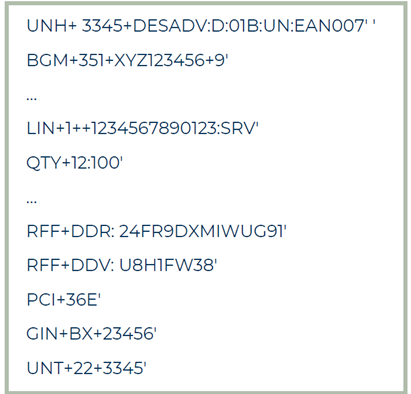
DESADV –
the transport vehicle of the EUDR
Supply chains are becoming more transparent and secure, as EUDR-relevant data can be standardized and transmitted efficiently.
Efficient EUDR delivery information
With the EDI message DESADV, companies have a proven tool at their disposal - one that not only transmits delivery information efficiently but also ensures EUDR-compliant documentation.
It’s no coincidence that the DESADV (despatch advice) — the standardized electronic delivery notification defined by the GS1 EANCOM© standard — is often referred to as “the digital backbone of the supply chain.” Why? Because in practice, it is used to transmit essential logistics data such as quantities, packaging details, and item numbers. Its primary purpose is to provide the recipient with detailed information about a delivery before or upon arrival, enabling optimal preparation for incoming goods — for example, by reserving the appropriate storage space, triggering automatic postings, or planning quality inspections.
DESADV takes on a new role
Going forward, the DESADV will also indicate whether an item falls under the EUDR regulation and whether the required Due Diligence Statement (DDS) has been created. The reference number of the DDS can be embedded directly within this message — effectively turning the DESADV into a transport vehicle for EUDR-relevant data. EDITEL supports its clients by providing customized mapping within its outsourcing services to ensure that all required fields are mapped correctly and in compliance with the standard. Even if another postponement of the EUDR is being discussed, it is advisable to make preparations early. After all, one thing is certain: postponed does not mean canceled.
Why is the DESADV used for the Due Diligence Statement (DDS) reference?
- Standardized and established: The DESADV is an internationally standardized EDI format (EDIFACT) and is already widely used across many supply chains. Adding DDS information does not require any fundamental system changes.
- Supply chain synchronization: The DESADV is sent before the physical delivery, making it the ideal moment to transmit the DDS reference.
- Automatable: Many companies already operate EDI systems, which makes integrating DDS data into the existing message simple and cost-effective.
- Integration into existing workflows: The recipient can process the DDS reference number and verification number directly within their goods receipt workflow.
- Secure transmission via established B2B networks: The message can be transmitted through a secure, established B2B integration network (EDI network). Such networks ensure fail-safe infrastructure and enable traceable, reliable transmission of sensitive EUDR-relevant data.
EUDR application deadlines
The EU Deforestation Regulation (EUDR, Regulation (EU) 2023/1115) requires companies to only place certain raw materials/products on the EU market, make them available, or export them if they can be proven to be
- are “deforestation-free” (not affected by deforestation/forest degradation),
- have been produced legally under the law of the country of origin, and
- a due diligence statement (including risk assessment/mitigation) is available.
Typically affected products include beef, cocoa, coffee, palm oil, soy, wood, and certain products made from them.
New status of negotiations (December 2025):
As part of the trilateral negotiations between the European Parliament and the Council, a compromise was reached to postpone the application of the EUDR and at the same time simplify certain obligations:
- Large and medium-sized enterprises must comply with the EUDR obligations from December 30, 2026.
- Small and micro-enterprises will be granted an additional transition period until June 30, 2027.
This agreement must still be formally adopted by the Parliament and the Council and published in the EU Official Journal before it becomes legally binding. If no agreement is reached, the current date of application of December 30, 2025, will remain in force.