Publication date: 12.05.2026
eFTI in the final stretch
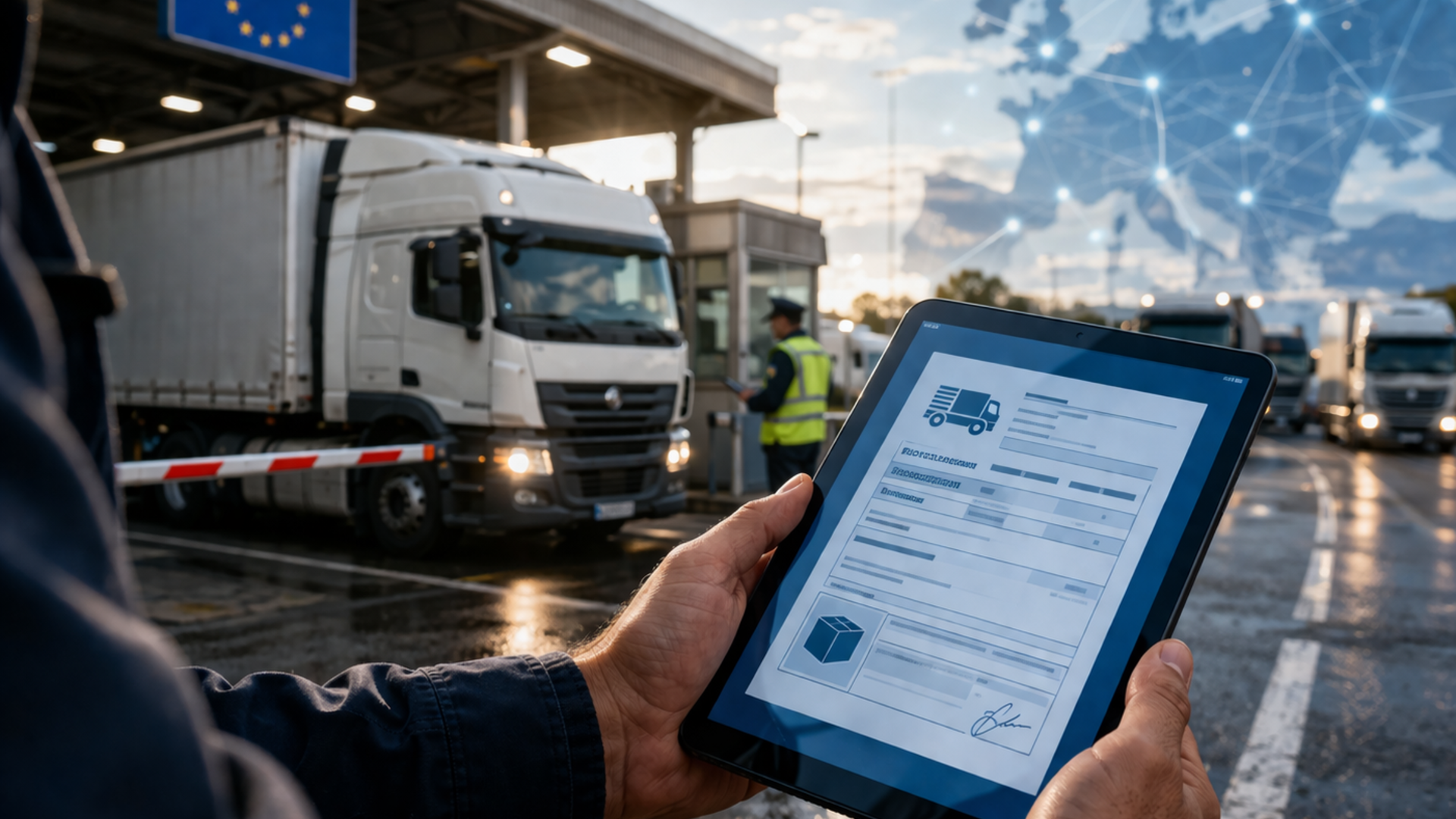
From July 2027, authorities in EU Member States that accept eFTI submissions must also be able to receive them.
Digitalization is gaining momentum
Spain has taken the lead – and across the rest of Europe, digitalization in logistics is also advancing rapidly. From July 2027, authorities in EU member states that accept eFTI notifications must also be able to receive them.
Spain is getting serious: from October 5 of this year, all transport operations moving through Spanish territory – whether domestic or cross-border – must be able to present a digital control document. The “Documento de Control Administrativo (DCA)” is a control instrument that must in future be presented in digital form during roadside inspections. In terms of content, the DCA largely corresponds to the CMR consignment note, which has been in use since 1956. Instead of a separate DCA, a correctly implemented electronic consignment note (eCMR) may also be used, provided it meets legal requirements.
Europe is preparing for eFTI
But it is not only Spain: Austria and Europe as a whole are also intensively preparing for digitalization in transport. The background is the eFTI Regulation (Electronic Freight Transport Information) from 2020. By July 2027, authorities in EU countries must be able to accept eFTI submissions.
In Austria, work is currently underway under the leadership of the Federal Ministry for Innovation, Mobility and Infrastructure (BMIMI) on an eFTI Gate, which certified eFTI platforms will be connected to in order to provide the necessary data. The Austrian IT service provider EDITEL – a specialist in digital logistics solutions – aims to be one of the first providers to offer a corresponding eFTI platform.
“With FreightLogs – our eCMR platform – we are well prepared to get started as quickly as possible,” explains Thomas Höfler, Product Manager eCMR at EDITEL. The eCMR solution has already been in use at LKW WALTER for some time – according to Trend magazine (Trend 500 – 2025), with revenues of more than 2.8 billion euros, the third-largest transport and logistics group in Austria after ÖBB and the Post.
Submission to the eFTI Gate
However, the planned implementation of the eFTI regulation on the authority side in 2027 is only the first step. From 2029 onwards, after an evaluation, companies are also expected to be required to submit the legally required information digitally – according to the current status.
“The positive aspect of the eFTI regulation is certainly that it creates a uniform legal framework within the EU. As an eFTI platform, we will then be able to transmit the necessary data from Austria to the eFTI Gate for our customers – regardless of which EU country the transport takes place in. For our eCMR customers, we will offer the submission of the required data as an add-on. In addition, there will be a standalone solution specifically for eFTI,” says Thomas Höfler.
Digital consignment note combined with e-invoicing
The implementation of the eFTI regulation is one thing – but an eCMR solution, such as the one offered by EDITEL, can do much more. It not only replaces the traditional paper consignment note in digital form, but is also a real enabler for further automation steps – for example in customs clearance or transport cost accounting.
“The automation of further business processes is the real appeal of FreightLogs,” says Höfler:
“Depending on the level of integration, the required data can be passed through to the ERP system and also used for the creation of digital invoices.”
eCMR combined with the creation of electronic invoices – a topic also related to the e-Invoicing obligation, which is currently already being implemented in some EU countries. Another key step toward digitalization that affects not only the transport and logistics sector, but companies overall.
Savings of up to 27 billion euros possible
Returning to eCMR: according to estimates by the European Commission, administrative costs in the transport and logistics sector could be reduced by up to 27 billion euros over the next 20 years. Per transport operation, around 15 minutes of working time could be saved according to the study “Digital Transformation: Advantages and Opportunities of E-CMR.” The automation of downstream business processes, such as customs clearance, is not yet included in this estimate.
The direction is therefore set. The majority of Austrian companies in the transport sector see digitalization as an opportunity – according to the EY study “Digital Transformation in Austrian SMEs” (2025). Around two-thirds (65%) of companies surveyed in the transport, traffic, and energy sectors view digitalization positively. Only one percent – the lowest value across all sectors – see it as a threat.
This article was published on May 8, 2026 in the New Business Logistics Guide(German edition).